
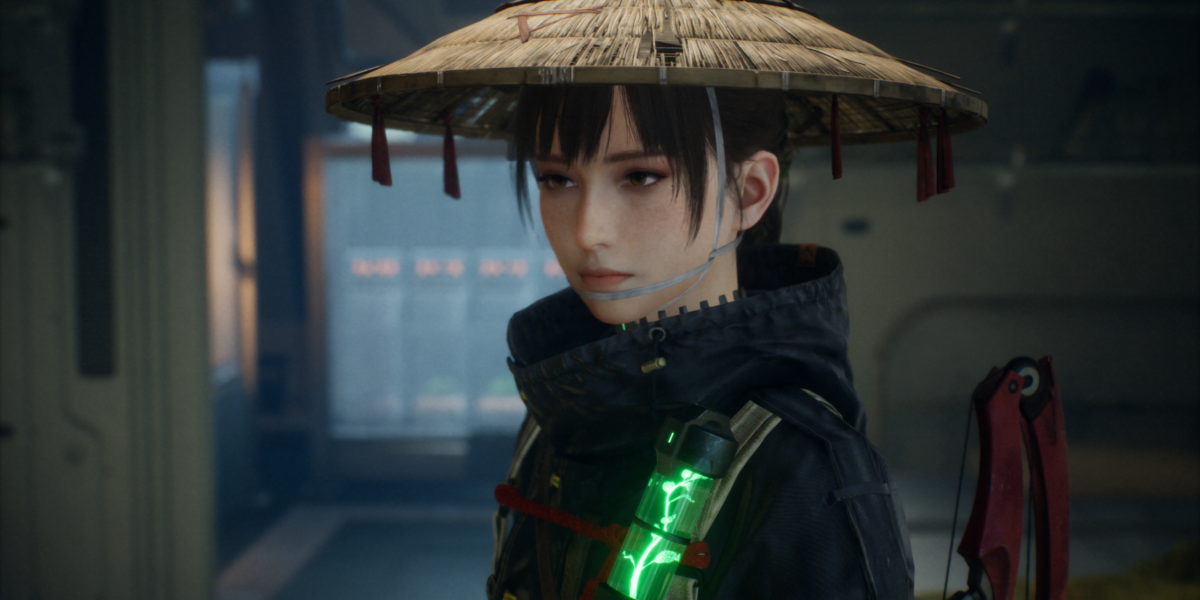
It’s summer and a good part of the team are on holiday, but we’re taking the opportunity that Beast of Reincarnation from Game Freak is available in Xbox’s Game Pass to test it.

| Type | Aventure Action |
| Publisher | Fictions Inc |
| Developer | Game Freak |
| Release Date | August 4, 2026 |
| Age Rating | 16 years and over |
| Physical | Visual | Hearing | Cognitive |
|---|---|---|---|
|
|
|
|
 Physical
 Visual
 Hearing
 Cognitive
 Full remapping
 Demanding bosses
We didn’t see it coming because Beast of Reincarnation is from Game Freak, the studio best known for Pokemon, which is radically changing course to launch itself into Action-RPGs.
Beast of Reincarnation thrusts us into a post-apocalyptic Japan in the year 4026. A curse, a blight, appears every 100 years and corrupts every living thing, both animal and human. To protect themselves, most humans have downloaded themselves into golems, conscious robots. The main character, Emma, however is the exception: she absorbs corruption without dying, but she lost her feelings. Emma is a Purifier. Her mission is to absorb the power of corrupted creatures with the help of a giant wolf, Koo, who is also corrupted.


Regarding gameplay, you’ll find all the basics of the genre. You have to develop your character using a skill tree, and this applies to Koo, too. You’ll equip both with equipment recovered from loot. A base, the mobile purifier, serves as a resting point and allows you to create recipes and improve your weapons before setting off again on the attack. The world is also semi-open, so you can’t visit everything at once, but you can move freely within each area once you’ve unlocked it. It’s necessarily reminiscent of Soulslike games with their arena boss fights, and Nier Automata also often comes up as a reference. We tested Beast of Reincarnation over two platforms, with Ivar on PC and Cad on Xbox, to get a complete overview of the game.
That’s it for the basics. It remains to be seen what it looks like when we look at it from the perspective of accessibility. We tested this live with Ivar, so watch the full French-language test video on our YouTube channel and we’ll get into the details about everything we learned from it below.
What if I have a physical disability? 6 / 10
On paper, Beast of Reincarnation starts off on the right foot. Controller configuration, like that of the keyboard, allows for complete key remapping. You can freely assign any action to any key. The game also plays well in hybrid keyboard/controller mode. Unlike other games where one disables the other, here, both controllers work simultaneously without latency. This allows you to mix hardware aids, such as Ivar’s ability to interact with switches, head movements, and voice commands.


However, this freedom has its limits. Joystick actions can’t be reattributed, so it’s impossible to play using only directional keys. You have to necessarily use a joystick or mouse to move and aim at the same time. The game also doesn’t clearly indicate key conflicts during remapping. You can see which key is involved by hovering over it, but in case of conflict, it’s up to you to spot the problem and manage it.
Regarding the camera, there’s axis inversion and a sensitivity setting that varies according to the action, whether it’s a movement or aiming. However, there isn’t any adjustable dead zone to manage uncontrolled movements, and automatic camera tracking, meant to remain behind the character, proved unreliable. It regularly got stuck against walls during combat, especially in the game’s very vertical areas.


Aim assist, however, functions well. It locks onto an enemy and automatically switches targets to another one once the fight has begun. Yet, it doesn’t apply to parrying, which remains entirely manual. There isn’t any automation for picking up common items either, but Koo can pick them up for you when he’s nearby. Chests containing rare items, on the other hand, sometimes require a quick-time event (QTE) involving combinations of directional arrows, up to five in a row within a very short time, so quick reflexes and fine motor skills are essential to get the best items.
The biggest problem lies with the skills. Many of them require unchangeable button combinations and reassigning individual buttons doesn’t alter the combination itself. The most glaring example is an essential skill that slows down time and allows for chaining attacks, requiring you to press both joysticks simultaneously. This is one of the worst control schemes you can find in a game, because unlike buttons, joysticks are unstable. and of course, this can’t be changed. Other skills require precise sequences, such as four presses of the back button (RB), followed by two presses of the X button, all to be executed within a limited time window.
The Soulslike boss fights add to these difficulties. Parrying must be timed perfectly with the attack, much like in Expedition 33 or Wo Long. Each successful parry fills Koo’s energy bar, allowing him to unleash his skills, making it essential for combat effectiveness, and not merely a convenience. The only way to mitigate this is by opening Koo’s skill selection menu, which significantly slows the fight without stopping it. This provides a few seconds to assess the situation, provided you’re far enough away from your opponent to do so. Opening your menu completely pauses the combat, but then you can’t see the situation anymore.
On paper, all of that seemed playable, but in practice, button mashing, long-holds and compulsory combos brought the score down to 6/10.
What if I’m visually impaired? 4 / 10
Unlike the physical settings, the visual options menu is very limited. It includes standard PC settings, but on consoles, the only worthwhile options are depth of field to get a better overview, and motion blur. However, the latter won’t prevent rapid camera movements, especially with the auto-aim feature that makes the camera move every which way.


There isn’t any color management, nor colorblind filter, yet color carries important gameplay information, like the need to dodge is indicated by a red alert. However, targeting handholds for jumping uses an electric blue that is quite resistant to color vision deficiencies. Colorblind players will therefore have to contend with a game that is less readable in this respect.
The real problem lies in the absence of sound or vibration feedback. There aren’t any collision sounds, so the character keeps running towards a wall without any warning that there’s an obstacle. Combined with the lack of sound for items or grab points, this makes the game unplayable for a visually impaired person. It’s worth reiterating that a game with this complexity level doesn’t necessarily make inaccessibility inevitable, for The Last of Us remains playable with impaired vision. Here, that’s not the case.


Guidance towards the objective takes the form of a discreet thread, which changes from blue to red as you approach. Aesthetically, it’s successful, we’re far from the big GPS-style white line of Assassin’s Creed Black Flag Resynced. However, this choice to be discreet comes at the price of accessibility, for the thread has little contrast and is hardly detectable for those with impaired vision, and the blue/red color change also poses a problem for people who have trouble distinguishing between these two shades. It’s the same thing for the grapple points allowing you to propel yourself forward using Emma’s mat because you have to be well positioned for them to be usable, without any obstacles in your line of sight.
Koo, the wolf, detects approaching enemies and displays them on the screen. This would, theoretically, help you find your way around without having to look for them yourself, but this form of identification remains very visual. Apart from a bark signaling the discovery, the position is indicated only by an arrow with little contrast. This, therefore, has limited usefulness for profiles which need it the most.
The subtitles complete the score. They’re displayed in white without an opaque background, which makes them unreadable against the light-colored game background. Size adjustment isn’t very effective, and even in the “very large” setting, it remains a problem. Speakers are identified by name, but without any indication of their on-screen positions.
In combat, QTEs also require good vision. Koo’s skills are activated by pressing a button at the right time during a period of about half a second. Since it’s displayed in shades of yellow, it can be difficult to anticipate. In addition, boss patterns have to be learned through observation, without sound support.
Both testers gave it similar scores, 3.5 and 4. We retain 4/10. As a useful reminder, at Capgame, 5/10 is the threshold below which we advise against the game for the specific profile. Beast of Reincarnation should therefore be avoided if you have a visual disability.
What if I have hearing loss ? 7 / 10
Regarding hearing, Beast of Reincarnation fares better, thanks to a generally clear interface. The sound settings are standard but effective. Gameplay effects are easily distinguishable from other sources, allowing players to isolate what’s essential. However, there isn’t any mono sound option, which is a drawback for those with peripheral hearing loss.


LSubtitles display speakers’ names, which is helpful. However, they don’t indicate their on-screen position and don’t convey non-verbal information, such as tone of voice. The same issue arises with visuals as with the subtitles themselves. Without an opaque background, they become difficult to read against certain backgrounds.
The most frustrating aspect concerns enemy positioning. Before a fight, Koo detects and signals approaching opponents, which is a valuable aid, but once combat begins, this assistance disappears. There isn’t any warning regarding an enemy approaching from behind, except for ranged attacks, which remain visible off-screen. Melee combat receives no such support. As a result, you’re often caught off guard by unexpected blows, and they can be quite painful. A video demonstrating this during a combat sequence is shown here.
The rest of the game relies heavily on a rich visual interface. This reduces your need to rely on sound to follow the action in general. We agreed on a score of 7/10, but make no mistake, this is below the usual average for this score, which is more often between 8 and 9.
What if I have a cognitive disability ? 5 / 10
On a cognitive level, Beast of Reincarnation demands a real assimilation process, without always being well-supported to achieve it.
Tutorials exist, but they’re poorly placed. They’re only accessible during rest periods or by navigating through at least three submenus: the character menu, then the directory, and finally the tutorial itself. Entries aren’t categorized, only listed in chronological order of discovery, without a screen reader to compensate. One small positive point is that each skill unlocked in the skill tree is accompanied by a short video illustrating its effect and its associated key, which helps with memorization.


However, there aren’t any training rooms, nor training dummies to practice combos before facing a boss. Yet, the game demands a really well-prepared strategy, for each opponent has their own elemental weaknesses such as fire, poison, or explosives, and you’ll have to adapt your skills accordingly, without any guidance to help you make that choice. For players who struggle to grasp this type of mechanic, simply rushing in with whatever equipment is available quickly proves useless.
Difficulty levels can be changed mid-game, upon returning to base, but settings remain vague about what they actually change. Again, everything is done via text, without a screen reader.
To help with navigation, the game offers a guidance thread to guide you to your main objective, but its activation is unreliable. There isn’t any minimap, only this thread and a possibility of placing a secondary marker, which doesn’t give any equivalent visual feedback. People with spatial awareness difficulties are therefore more likely to get lost than when using a traditional mini-map.
The game is only available in Japanese or English (audio only), with French subtitles only [sic.]. Text scrolls automatically, without speed adjustment, which is a disadvantage for players who need more time to read. Another significant drawback is that keywords aren’t color-coded in the menus, making it difficult to quickly locate useful information.


Finally, the game interface displays many markers at the same time, such as objectives, enemies and items. This wealth of information is useful for some players, but problematic for others who struggle to manage too many on-screen elements at once. Unlike other games that allow you to enable or disable these elements individually, no such option is available here.
Both testers gave similar scores: 6 for Ivar and 5 for Cad, who notably pointed out the language barrier. The final score is 5/10, because text scrolls quite quickly, and since it’s important for understanding the story; also the lack of French-language support can be a real hindrance.
Our opinion
Beast of Reincarnation perfectly illustrates the gap between good intentions on paper and a harsher gameplay reality. Full key remapping and auto-aim give a favorable first impression of physical support options, before mandatory combos and boss fights catch up with everyone.
Visually, the picture is more stark, with a near-total lack of options, coupled with subtle but low-contrast guidance excluding a large portion of the target audience. Sound remains the game’s relative strength, thanks to a highly-visual interface, but loses ground regarding enemy management during combat. Finally, cognitive support suffers from insufficient adaptations for a gameplay system that demands a great deal of strategy and memorization.